

Delighted to see the inaugural issue of the new journal, Silk Roads Archaeology and Heritage edited by colleagues at UCL, Institute of Archaeology. Also relieved that it has provided a home for an article of mine long in the making, as well as for excellent articles and reports by other scholars. Several papers are already available online, and others will appear shortly. Congratulations to the editors for their excellent work on producing what promises to be a major source of scholarship in this ever-expanding field.
Helen Wang and I were invited to be guest editors of this issue to bring together articles and reports on Aurel Stein and the Silk Roads. Having worked together on several projects relating to Stein, his collections, and the Silk Road, we were keen to highlight more recent developments by both our generation and a newer generation of curators, conservators and other scholars. We dedicated the journal to Dr Binoy Kumar Sahay, long time curator of the Stein collection at the National Museum of India in New Delhi, who sadly died in 2021. He had been working on the new galleries of Stein collection paintings and other artefacts at the NMI but did not live to see their opening in May 2022. Like us, he worked on the Stein collections for about a quarter of a century, and, largely self-taught in this field, developed a very thorough knowledge of the collection, curated exhibitions and displays, and was part of its initial digitisation. He is very much missed. I hope to have a report on the new galleries ready for the next issue.

Both Helen and myself, along with other curators of material from the excavations in eastern central Asia in the early 20th century, have sought to make the Stein and other material more accessible both through conservation and cataloguing, but also by publishing lists and reports on the collections and their history. Although these are absolutely essential for navigating and understanding the collections, they are often prepared in concise formats for easy reference and do not necessarily lend themselves to publication in academic journals. Thanks to Helen, much material has been published in several issues of the British Museum Occasional Papers. This initial issue of the SRAH highlights the importance of such collaborative curatorial work and how it is fundamental for further research on the collections.
Personally, I was relieved to have a home for an article that I started years ago when curator at the British Library. This is a detailed review of the various identification systems used by Aurel Stein for the material from the Dunhuang Library Cave. Although mentioned previously by scholars such as Rong Xinjiang and used by them to discuss the contents of the cave, their work always only gave a partial explanation as they did not have access to all the archives. When Paschalia Terzi came to the Library as an Erasmus scholar, she provided an impetus by carrying out some vital archival research and suggesting a path through the intricacies of Stein’s systems. I did not have time to continue this work until the past few years after I had left the British Library. A Leverhulme Turst Emeritus Fellowship gave me the opportunity to spend considerable time in the Stein archives in the Bodleian Library to research a forthcoming book on the history of Khotan. I was able to follow up on the outstanding queries and further navigate the often confusing paths through Stein’s systems. In addition, with the help of Mélodie Doumy at the British Library—whose paper on Bonin is included in this issue—I tracked down some additional scroll wrappers from the Library Cave with annotations by Jiang Xiaowan (see below).
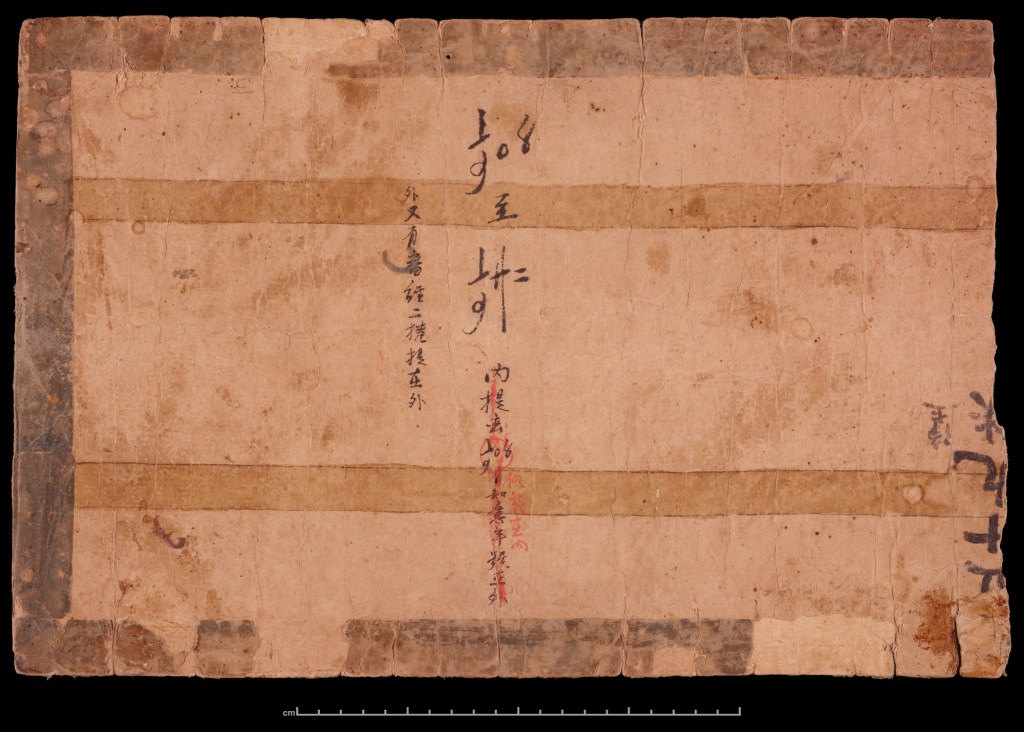
The resulting paper is inevitably long and dense as it seeks to bring together all the disparate data on this topic so that scholars in the future do not have to do this archival research again. Instead, we hope that it will provide the foundations which will lead to new scholarship on the contents of individual bundles stored in the Dunhuang Library Cave.
NB
Been a while since I posted, but busy with travels (Japan/Korea/Pakistan), exhibitions (Nara to Norwich, online and virtual) and several other publications. More on all these to follow soon!
 Silk Road Digressions
Thanks for the wonderful erudite articles on Silk Road. Read your article on Khotan. Appreciate the information provided by you. Want to know if you will accept articles on cities along the Asian Silk Road.
LikeLike
Thanks but I am not editor of the journal. You can sumbit an article directly to them for consideration. Good luck! Susan
LikeLike