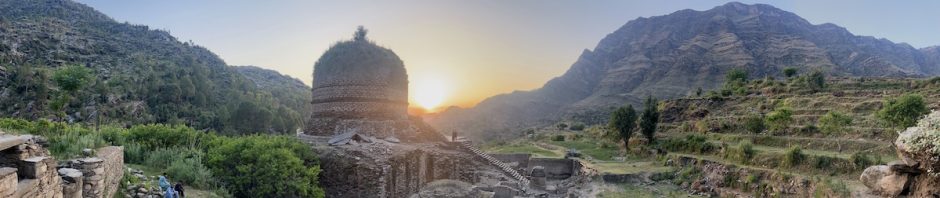

Amluk Dara, literally ‘wild persimmon hill’, is used to name a Buddhist stupa and monastic complex in the Swat valley in northwestern Pakistan. It was visited, drawn, photographed and partially excavated by Aurel Stein during his tour to Swat in March 1926 and then by Berger and Wright in 1938. Restoration was carried out in 1958-9 by the Department of Archaeology and Museums, Pakistan and again in 1968, when the stupa was also studied by Italian archaeologists and Kuwayama, But its was not until between 2012 to 2015 that systematic excavation took place. This was carried out by the Italian Archaeological Mission led by its Director, Luca Olivieri (Olivieri 2014). Reading Stein’s account and the detailed Italian report led me to make the stupa focus of one of my chapters in Silk, Slaves and Stupas, published in 2019. I also had the opportunity then to visit the stupa and many other Buddhist sites in the Swat valley as a guest of the Italian Arcaheological Mission to Pakistan (ISMEO) and wrote about it in an earlier blog post. I returned earlier this year.
Further Discoveries
The stupa and its surrounding structures, which were relatively easily accessible and left in excellent state by the Italian archaeologists, become a draw for groups of tourists, especially those interested in Buddhism. In 2019–2020, DOAM, Khyber Pakhtunkhwa carried out a further excavation of the site uncovering new structures and sculptures, mostly relief panels (Samad et al. 2021 and Yousaf 2022). However, the heavy rainfall and subsequent floods in Swat in 2022 resulted in notable damage, such as the erosion of the earth wall at the edge of the excavations. The terrace, which had been restored and made safe, is now fragmentary in areas, and part of the stupa is in disrepair.
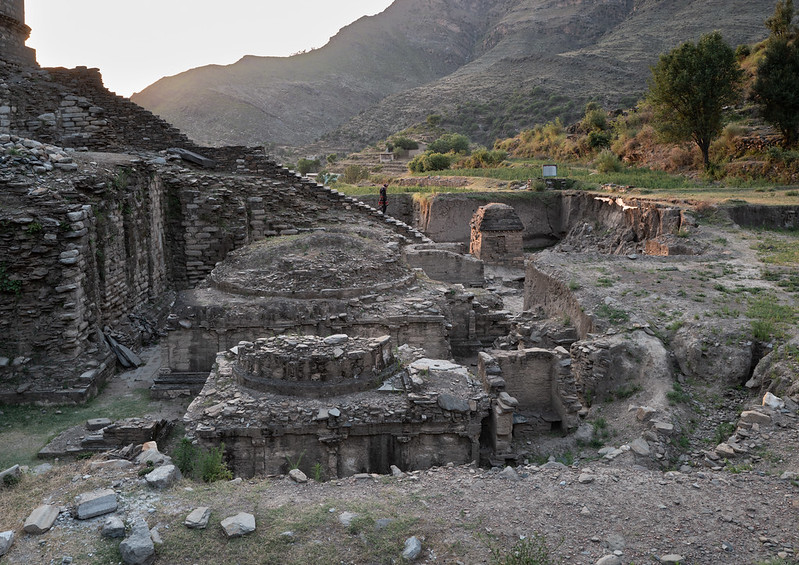
There were signs of work at the site, and it is hoped that this damage will be addressed quickly. As one of the most notable and striking sites in the Swat, nestling in the shadow of Mount Ilam, it is hoped the stupa made suitable again for tourists to visit to learn about the Buddhist history of this important Silk Road kingdom.
Thanks to Luca Olivieri for enabling this visit, colleagues are the Mission for hosting us, Shafiq for generously and enthusiastically sharing his immense knowledge and taking us to numerous archaeological sights and rock carvings, and to John Falconer and Alice Caselini for their excellent company, photography and insights.
Note: The banner photograph for this blog is of Amluk dara looking down the valley taken during this visit.
Bibliography
Abdul Samad, M. W. 2021. Amlukdara Swat Excavation and Conservation Report 2019-2020. Directorate of Archaeology and Museums Goverment of Khyber Pakhtunkhwa Peshawar.
Berger, Evert and Philip Wright. 1941. Excavation in Swat and Exploration in the Oxus Territories of Afghanistan. Government of India Press. Rpt . Sri Satguru Publications 1985.
Olivieri, Luca M. 2014. The Last Phases of the Urban Site of bir-Kot-Ghwandai (Barikot): The Buddhist Sites of Gumbat and Amluk-Dara (Barikot). Lahore: Sang-e-Meel Publications.
Stein, M. Aurel. 1929. On Alexander’s Track to the Indus: Personal Narrative of Explorations on the North-West Frontier of India. London: Macmillan. http://archive.org/stream/onalexanderstrac035425mbp/onalexanderstrac035425mbp_djvu.txt.
Whitfield, Susan. 2019. Silk, Slaves, and Stupas: Material Culture of the Silk Road. University of California Press.
Yousaf, Zubaida. 2022. “Narrative Relief Panels from Amlukdata (Swat) Excavatin 2019 2020: Reidentification and Reinterpretation ” Pakistan Heritage 14: 65–75.
 Silk Road Digressions